Monday, July 1, 2013

Touring the DMZ

After two and a half years here I've finally made it up to the Demilitarized Zone, north of Seoul. Because there's without doubt a thousand other accounts already floating around online about the layout of the tour, I'll suffice to give a fairly brief account here.

We started at the USO in Seoul (USO, as explained by one of my American traveling companions, being the organization for morale boosting/recreational activities for the U.S. military).  There we boarded a bus and met our Korean-American tour guide, Brandon.  Brandon gave us the basic rundown on the DMZ during the hour long ride towards it.

Because our tour, unlike many of them, was going to include the JSA (Joint Security Area/Panmunjom), the dress code was fairly strict.  Even though it was hot there was to be no shoulders shown or shorts higher than the knees, though pants were preferred.

We entered the DMZ and the bus wove between a series of strategically placed barriers of either side of the road, presumably designed to cause traffic to go slow and be rolled back into place if need be.  When we reached the entrance to the JSA, Brandon announced that a U.S. soldier would take over for that portion of the tour and that we should do everything he said.  The man who came to tell us to board a different bus for the ride into the JSA, bringing our cameras but absolutely no bags, had a firearm holstered at his side, reflective sunglasses, and a demeanor that suggested immediate reprimanding should we mess up.  That's when this tour got real.
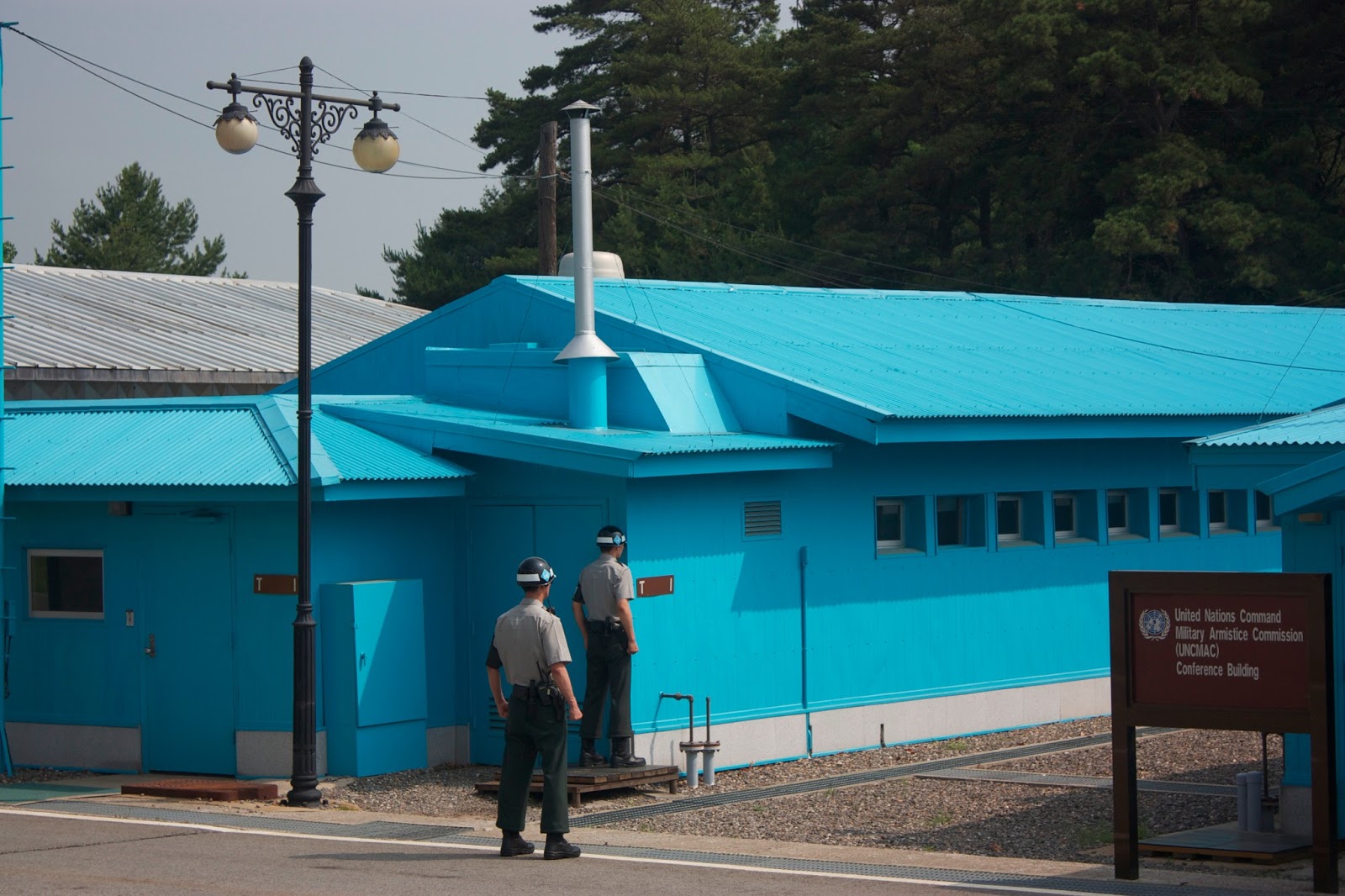
Our first stop in the JSA was the infamous Panmunjom.  Where small blue buildings flank a concrete line that marks the border between North and South Korea.  Initially, three soldiers stood at the ready, left, right and center, "for our protection," though it was obviously more posturing than anything.  If the opposite side wanted, a sniper could have taken us out from a window of the looming North Korean building at any time.  Our military guide explained that they were only standing at the ready since we were there, but when there was no visitors they relaxed.  None of this is to say the experience wasn't very cool.  Panmunjom is iconic, and it wouldn't have been complete without soldiers standing statue still, hands balled in fists, staring down the North Korean guard on the opposite side, who in turn watched us back through a pair of binoculars.

Wednesday, June 26, 2013

Shizuoka and Ise

Earlier this month I bought a last-minute plane ticket to Shizuoka for a four-day weekend.  I flew in to the new (and small) Shizuoka Fuji airport, only completed in 2009.  It was the first time I've been back to Shizuoka since moving away almost three years ago.  I got to meet some old friends, and take an fantastic road trip with one of them to Ise (home of Ise Grand Shrine, dedicated to the major deity Amaterasu, goddess of the sun in the Shinto religion). This is considered to be the most sacred shrine in Japan, though it was my first time there. Interestingly, every 20 years the main buildings of this shrine and destroyed and rebuilt nearby to the previous.  When we were there the new ones were currently in construction.

Also on our jaunt to Ise we visited a huge aquarium, or at least the largest one I've been to.  The trip overall was packed to the brim with activity and nostalgia, and could hardly have been better.

Fujisan from the airplane on approach to Shizuoka airport.

Monday, May 20, 2013

Sigur Rós in Seoul

Last night (Sunday, May 19th) myself and three friends at long last attended the Sigur Ros concert at the Olympic Stadium in Seoul, part of their 2013 world tour.  When I first heard months ago that they were coming to South Korea I almost couldn't believe my luck.  A chance to see Sigur Ros live?  Hadn't seen that one coming.


Here's the thing: Korea is small enough that it is easily possible to get anywhere to see anything in the country within the space of a weekend.  It's a matter of purchasing a bus or train ticket and being on
your way.  I'm located quite centrally, about two and half hours drive from Seoul in the north and three to Busan on the south coast.  Contrast this with my hometown in Canada.  To get to the provincial capital, Halifax, it was a three hour drive.  Halifax is also where the airport is, which you would need in order to get to Toronto and beyond, unless you have a vehicle at your disposal and days to spare for the drive (or there's always buses, may God have mercy on your soul).  As far as flying out to a large city for something like a concert when I was growing up, ha!  Don't make me laugh.

Monday, May 13, 2013

Better to Light a Candle . . .


Paper lanterns are strung throughout Yecheon for a number of weeks leading up to the Buddha's birthday celebrations on May 17th.  They glow throughout the warm spring nights, keeping the dark at bay even around small temples such as this one, tucked away at the back of town, far from the main thoroughfares.

Saturday, March 2, 2013

Return: Kyushu Through Fresh Eyes

While I had thought that my first trip back to Japan would be made to Shizuoka, it ended up being Kyushu.  My friend Sean had long wanted us to travel there together, and when we found out that a chunk of our time off for the Korean spring break coincided, we jumped on the opportunity.  Rather than a plane, we instead took the JR Beetle, a jet foil ferry running between Busan and Fukuoka.  The ride was only three hours, port to port.

Sean had never been to Japan, so in a way I felt able to see it all for the first time again, vicariously recapturing some of the experiences and feelings I had back in 2008 when I first set foot there.  I planned for us to go directly from Fukuoka to Nagasaki, from Nagasaki to Saga, and then return to Fukuoka for the last days of our trip.  Though I had been to both Fukuoka and Nagasaki before, it sometimes felt like an entirely new experience and at other times was tinged with nostalgia and stark recollections.

Our short trip was great from start to finish, with many highlights.  Without realising it, I had booked us spots at the same hostel in Nagasaki (International Youth Hostel AKARI) that I had stayed in on my first trip there.  It was impossible not to recall it as we disembarked from one of the city's signature trams and walked into the old part of the city, where stone arched bridges still span the river and the ground rises gently toward a nearby four hundred year-old temple that survived the 1945 atomic bombing.


Tuesday, February 5, 2013

Winter in the Land of Morning Calm

It's been a fairly quiet time here in Yecheon this winter, post-Taiwan.  I've stuck pretty close to home and had a nice season so far, which has ranged from bitter colds, snow and ice to surprisingly spring-like warms with meltwater running in the streets. 

One recent highlight was speaking at the 2013 Secondary English Teachers Association Workshop in the city of Gyeongju back in early January (my presentation, Global Language, Global Access: Utilising Technology to Facilitate English Acquisition, was a fancily labeled talk putting forth some ideas for incorporating smart phones, the internet and online resources into the EFL classroom).  I also had a visit last month from a great friend of mine, Chris, who I studied with in the Dalhousie Acting program, and who I've managed to reunite with four times in three countries since we graduated in 2008--something neither of could have ever foreseen during our hectic university years in Halifax.

Anyway, I've been out and about with the camera as well, so I'm putting up some select shots from the last few months, mostly from around Yecheon county, starting with woodpeckers in the mountains.


Thursday, January 3, 2013

Taiwan, or There and Back Again

And there's a fake part of me
that comes off so you can read
I was made by the Taiwanese in Taiwan
but they don't like that much
because it's called Formosa

-Matthew Good Band, The Workers Sing A Song Of Mass Production

Taiwan is a place that, as far as I can remember for most of my life, if I thought about it at all, I associated with the Made in Taiwan stamps on the bottom of a dish or plastic toy here and there.  Naturally most people with that kind of simple indoctrination to the word "Taiwan" are going to envision it as a place of sprawling factories, maybe interspersed with sweat shops, all wreathed in the heavy clouds of smog synonymous in our collective consciousness with the parts of the world who make all the odds and ends for the parts that don't.  I can't speak for the past, but modern Taiwan, at least, does not fit that picture.

Taiwan was formerly known as Formosa, as a result of Portuguese sailors terming it llha Formosa, or "beautiful island" after first catching sight of it in 1544.  Their ocean-weary eyes clearly didn't betray them, as beautiful it is.  After rapid industrialisation ("Made in Taiwan") and economic growth in the latter half the 20th century, Taiwan has now become an advanced industrial economy.  Unlike its big brother to the east (and southeast and northeast) across the Taiwan straight, Taiwan is a multi-party democracy, though still officially  known at the Republic of China, or ROC (as opposed to the People's Republic of China, or PRC, as the PRC refuses to recognise Taiwan as a sovereign state).

Taiwan was mostly inhabited by the Taiwanese indigenous peoples when the dutch showed up, after which Chinese began immigrating to the island, the descendants of which now form the majority of its populace.

Now that you know the same scant amount about the country's history as I do, let's get down to business on the trip itself.

Saturday, November 10, 2012

Autumn in Gyeongju


A trip to the city of Gyeongju, as an extracurricular field trip with students from Daechang high school and various teachers, gave me an opportunity to capture some of vibrant fall foliage around Cheongmachong (천마총) royal tomb area and the Bulguksa (불국사) temple complex.  Gyeongju was the capital of Silla (the united three kingdoms) during the long dynasty of the same name, from BC 57 to AD 935.  The city is filled with historical relics from that period.  It was a fortuitous weekend to have gone, as the leaves have reached their peak in color there and will soon be on the ground, as most already are here in Yecheon a bit further north.  In particular the maples were out in force, most spectacular in their range between fiery oranges and blood reds.


Wednesday, May 30, 2012

The Dokdo Trip

Thursday, May 24th:  by 7:30am I was already on a bus to the coastal city of Pohang.  From there myself and a group of other teachers selected for the annual Dokdo trip boarded a boat bound for the island of Ulleungo in the East Sea (Sea of Japan).  The purpose of the trip, organized by the Gyeonsangbuk-do Provincial Office of Education (POE), was somewhat twofold.  For one, it was an opportunity to present lectures and promote discussion on the history and issues of international law involving the twin islets (dongdo and seodo) known jointly as Dokdo, and it was a series of photo-ops to document this large presence of foreigners learning about the issue and setting foot on the island (or at least the concrete dock we were limited to).  Case in point, I was interviewed by a TV crew about my thoughts on the island a few moments after disembarking from the ferry.

In brief, the issue surrounding Dokdo is that both Korea and Japan have both long laid claim to it, still without resolution (it sits in the ocean 87.4 km southeast of Ulleungdo and 157.5km northwest of Japan's Oki island, off the coast of Shimane prefecture).  To this end Korea has built some facilities to house and support a fisherman and his wife, as well as about a dozen or so police officers stationed on the island.  South Korea is desperate to raise international awareness of the issue, as it has been largely ignored outside of the country and certain groups within the Japanese government, which is the main reason efforts are undertaken each year to bring teachers currently serving with EPIK to Ulleungdo and Dokdo.  In terms of a legal battle, Korea is not confident in going with Japan to trial in international courts over the dispute because they (apparently) feel that Japan, as a larger and more powerful country, will hold more sway in such an arena.  The risk of losing Dokdo is absolutely unacceptable to most Koreans.

Tuesday, May 8, 2012

Springtime in Korea; Trekking and Tromping

Cherry blossoms near the riverside in Yecheon
Ji Hye and I take an afternoon trip out to the small farming village she grew up in.  It's small and quiet enough that when we arrived an old woman near the taxi we were getting out of cried: "oh, looks like we've got a special guest here today!"


A statue of King Sejong, who created the Korean alphabet, Hangul, sits in front of the now-closed elementary school.  Children from the village now attend classes in a more populous area.


The old slide evidently still sees lots of use from children in the village.  These girls are all sisters.

Tuesday, April 10, 2012

Cherry Blossoms and Plesiosaurs

A trip to Jinhae this weekend (April 7th-8th)  on the RoK's southern coast, revealed a big white explosion of Spring.  Jinhae is the cherry blossom capital of South Korea, and as you'll see from the pictures, it didn't disappoint.

Cherry blossom blooming tends to be quite regular each year here in East Asia, and the beginning of the season can usually be predicted down to within a few days.  In both Japan and Korea, the blossoms generally bloom first at the most southern areas of the country (there are exceptions in the case of micro-climates), and then sweep up through the country over a period of weeks.  In Japan this is called the sakura zensen (桜前線) or "cherry blossom front."

Cherry blossoms are always the surest sign that spring has come to the land once again.  It was a weekend of warm weather and flawless blue skies.  As usual there was nary a downtrodden face to be seen beneath this part of the world's most beautiful, yet fleeting, confirmation of new life and the passage of the seasons.


Tuesday, March 20, 2012

Hitting The Culinary Wall

By now I think I've eaten a lot of what many would consider to be questionable/strange foods.  I'm willing to try new eatables when the opportunity presents itself: jellyfish (dried and chewy, tastes like what jellyfish are made of: virtually nothing), squid ink pasta (inoffensive, pleasantly salty), scorpions (tasty, with a crunch that can't be beat), grasshoppers (sweet n' crispy), silk worm larva (earthy and soft without being gooey), raw horse meat (you'd hardly know it wasn't sashimi),  fugu (tender, fresh, legitimately considered beforehand that it might be my last meal), and so on.  There are some things I won't eat, such as shark fin soup (on the menu at a restaurant in China one night) or things that are able to consciously look around the inside of my mouth before I chew.  This post concerns the latter.

Tuesday, February 28, 2012

Gangwon-do: Chiaksan National Park (치악산국립 공원)

After departing Sokcho we were bound for Pyeongchang, future home of the 2018 Winter Olympics.  Pyeongchang's claim to fame is a large ski resort called Alpensia where the Games will be hosted six years from now (Pyeongchang was finally awarded the games, to much elation, after two unsuccessful bids in the past).  We weren't planning on skiing on this trip (though I have gone twice in Gangwon-do this winter at a great resort called Vivaldi), so we didn't so much as glimpse Alpensia on our long trip down the expressway cutting Southwestwards towards Pyeongchang town itself.

Pyeongchang town's river
Actually I should be clear: we didn't do very much research on Pyeongchang (my draw to it initially was simply the fact that it had been recently awarded the Olympics), and thought that the capital of the county was actually a  city.  We were a little bit surprised when our bus pulled in to a very small station with no buildings insight, by a sign indicating that we'd indeed reached our destination.  We found ourselves in a very small place.  A few minutes later another foreign teacher approached us on the street and informed us we were on the main drag.  Then and there Brent and I decided that we'd stay for a little while longer and see what we could and then make for the city of Wonju in the evening.  We ended up crossing the town's resident river and climbing a hiking path up the hill on the other side.  At the top we were able to take it the whole city which was actually quite a lovely, rustic looking place nestled in the hills.  Korean totem poles, called Jangseung (장승), carved traditionally as village guardians, abounded along the river front.

Monday, February 27, 2012

Gangwon-do: Geojin (거진)

Heading north up the east coast from Sokcho, our next stop was the small town of Geojin.  This was the furthest the the bus would take us, as Geojin is also the last town before civilization begins to quickly peter out on the final stretch to the DMZ, called hyujeonseon (휴전선).  Beyond Geojin lies several museums (Hwajinpo Marine Museum, Hwajinpo History and Security Museum and a DMZ museum) as well as a Unification Observatory and Unification Security Park.  In the end we would never make it to any of these, and while I don't know how grand any of those places were, I have to judge based on Geojin itself that they wouldn't be too large in scale.

Even during the bus ride to the town, the view of the beaches began to change.  High fences began to appear where the sand ended, topped with curling twines of barbed wire--the first visible signs of barriers to keep possible North Korean interlopers out.  A feeling of desolation settled over me as we arrived in town in the mid-afternoon.  The gray sky above probably added to some of that, but there was no doubt that Geojin was a town with a bitter past and a bleak present.  It's streets could hardly be said to buzz with life and a particular quiet seemed permanently clamped down over the whole area.  Rusted barbed wire fencing covered the sides of random buildings, some of them next to the sidewalk of the main street, and a few featured new barbs that had been twisted on recently enough to still maintain their silver gray color.  We wandered down this main street from where the bus had  dropped us and done a u-turn at its final stop and soon veered off towards the water.  A military ship sat at port in the chilly breeze and as I drew my camera to take a picture some young soldiers appeared off to our side behind chain link fencing.  "This is Korean Navy ship," one said in English. "No pictures."

Gangwon-do: Sokcho and Seoraksan (설악산)

Having enjoyed my time spent in the northern prefectures of Honshu island in Japan, I knew that taking a trip to the north-eastern province of South Korea, Gangwon-do, couldn't be a bad idea.  Gangwon-do is bordered on its Eastern side by the East Sea (Sea of Japan), with its long stretches of sandy coast and crystal clear turquoise water and the DMZ (demilitarized zone) to the north.

For the trip, planned to last six days, I met up with my friend Brent in Daegu and proceeded to take an early morning six hour train ride northwards to the seaside town of Jeongdongjin (정동진).  I'd been here before in the summer and it was worth another visit, particularly because we could take a fairly easy bus ride to our first main destination of Sokcho from there.  In the summer I had gone swimming in the brilliant surf at Jeongdongjin beach, though of course all we could do now was look at the waves.  The train station is practically located on the beach, and it's possible to be walking through sand less than a minute after disembarking.

After eating a lunch of fish and walking about the town, we grabbed a bus for the small city of Sokcho further on up the coast.  We didn't arrive until after dark, and so it was only the next morning when we say the jagged, towering mass of the Taebaek ( 태백) mountain range cutting into the sky just beyond the limits of the city, our day's destination, Seoraksan, being the highest among them.  I've seen and climbed plenty of mountains in Asia, some far taller than those of the Taebaek range, but the sheer stony and snow frosted ruggedness of the view from Sokcho felt new to me.  Brent commented that they reminded him of the Rockies, though (perhaps ironically, as a Canadian) I've only seen the Rockies distantly from the window of the Vancouver airport.


Thursday, February 2, 2012

Cambodia: The Wedding Party

We are led to our table
Why Not smiles across the table.
On my last day in Siem Reap the owner of Angkor Wonder Hostel, where I was staying, invited me to come to a wedding party which would be on later that night.  That evening I came down to the lobby to find nine other travelers that he had asked to come as well.  He (his name is pronounced and self-spelled "Why Not"--also his favorite English catch phrase) already had tuk-tuk drivers waiting and they sped us off into the night for a fifteen or twenty minute ride to a tented area on the outskirts of the city.

We didn't know at the time who was getting married exactly, nor do I think the other guests expected to see us show up.  However, when we did, we were immediately welcomed warmly and ushered to a table.  Why Not and a server brought us bottles of Angkor beer, and before we could even begin to say thank you, told us to drink lots and whenever we wanted more, just to ask.  "Please enjoy yourselves," he said.  "I want you to feel this is your home."  The first round of food soon came out, an assorted meat platter, salad, fish.  The bride and groom came over to meet us, looking lovely and flush.  I looked around at the people--men in their suits, women with their hair done up, make up and their best dresses, and it occurred to me how special it must be for them to have an opportunity to do themselves up like that.  Most people are just doing what they can to get by each day and don't have the time or necessarily a reason to do anything beyond the necessities.

Cambodia: The Killing Fields and Tuol Sleng Genocide Museum

The Killing Fields are a dismal and raw reminder of the Khmer Rouge's social engineering and rule in Cambodia.  Led by Pol Pot, who envisioned an agrarian-based communist society which devoted its human resources to agricultural output, particularly a massive increase in rice production, the Khmer Rouge carried out a massive genocide mainly between 1975 and 1978.  This was inspired by Pol Pot's ideology of self reliance, similar sounding to the juche philosophy which is idealized by North Korea.  In this new agrarian-based society, individuals educated in any kind of Western or non-agricultural practice, such as the doctors and lawyers in Cambodia at that time, were summarily rounded up and executed at killing fields like Choeung Ek, which I visited outside Phnom Penh.  Many were kept and tortured first in the Tuol Sleng center, now the Genocide museum.

Though today the number killed is debated, most estimates put it somewhere between 1.4 million and 2.2 million, or, as the audio guide we were given at Choeung Ek said: think of your own country, and imagine if one and every five people in it were murdered.

Tuesday, January 31, 2012

Cambodia: Exploring Angkor

Even with crowds of people migrating towards it, Angkor Wat dwarfs them and makes all those heading to the sanctum behind its stone walls seem fleeting in their passage.  At no point as I walked the stone bridge across the moat did I feel that there were simply too many people.  The gargantuan nature of the complex defied such a sensation.  I passed beyond the outer wall and entered the massive courtyard further along where the iconic five-tiered temple  of the Wat itself looms with timeless power.  Unfortunately during my visit (and this season, if not year, in general) safeguarding construction is being undertaken on the main structure, highlighted by large green curtains.  No matter though, Angkor Wat provided an unexpected amount of roaming room.


I'll mention now that one of the most impressive things about Angkor, besides the architecture, obviously, is just how freely visitors can roam.  Once you've bought your pass (one day, three day or one week) and have passed into the territory you are at liberty to explore as freely and extensively as you wish until closing time in the early evening.  For two of the three days I rented a bicycle, which I overall preferred to the popular tuk-tuk method, and enjoyed taking as much time as I wanted to explore every corner a given temple if I so chose to.

As far as I can tell from my map I managed to visit every temple within the main area of Angkor, consisting of Angkor Wat, Angkor Thom and the temples along what are known as the "short circuit" and the "long circuit".  I could go into detail to describe each, but rather than do that I'll suffice by posting some of my pictures here, though if ever it could be said that pictures won't properly convey a place, this would be a prime example.

Sunday, January 29, 2012

Cambodia: The Road to Angkor

Journal excerpt, January 17th, 2012

I wake up to the gentle breeze of an air conditioner blowing over my shorts-clad legs.  What??  I left Korea in strict sub-zero temperatures yesterday afternoon, the han-cheon river running through Yecheon frozen solid enough to skate on--is this really possible?  I roll out of bed and trudge into the shared bathroom of the dorm style room I'm staying in at the Mad Monkey hostel.  I shower and go downstairs to the lobby, one side open to the street, and get my first glimpse of Cambodia in daylight.

Last night my plane got in late and after taxiing to drop of my bags at the hostel I went out in search of cheap eats.  I was immersed in humidity, recalling drenched memories of summer in Japan and Korea, except amazingly it's mid-January.  Definitely the furthest south I've ever been.

After eating my first Cambodian dish--a bunch of things I pointed to all placed on a plate, including curried stewed beef, eggs and rice--a hostel mate I had just met and I ordered a couple domestic beers for the road and then discovered we couldn't find our hostel again (later we'd discover that this was because they turned off the lights, took the signs in and closed the steel gates out front for security after a certain hour).  After wandering around a half-lit suburb of Phnom Penh, palm fronds and exotic plants looming lusciously in tropical shadows off and over the street, we finally gave up and paid a passing tuk-tuk (motorcycle pulling a small carriage) to find our hostel for us.  After even he circled through the area twice without finding it, he was successful and I crashed in my bed to wake up this morning.

I order some food for breakfast and sit down to wait, glad I got up early and have a full day ahead.  Outside I can see massive tropical plants fanning out greenly in front of buildings.  Green!  The air smells moist, fertile and decidedly wild, even here in the capital.

Today I head out to Siem Reap where I'll stay for the next four nights.  I've bought my bus ticket already, opting for the six hour bus (as opposed to the four hour option), intent on taking in lots of the countryside of this jungle rich land.  Ahead of me after that lay the temples of Angkor.

Tuesday, January 3, 2012

Korean Temple Stay (동화사)

On New Years eve I did a temple stay at Donghwa-sa temple, outside of Daegu, where we could get a taste of the Korean monk's daily life.  We wore traditional clothing and moved throughout the complex to different buildings where we met monks, chanted, bowed and prayed with them (a Buddhist monk spends the majority of their waking hours praying and meditating).  Additionally, we each made a Buddhist necklace from 108 wooden beads (one for each sin man is prone to according to Buddhism).  To do this we had to fall to our knees and bow deeply, then string a single bead, after which we would stand, then go to our knees again and repeat until we had done this 108 times, completing the necklace.

In the evening we were able to have a long Q and A with one of the monks over tea.  I've often been curious about what drives people to become monks.  Fortunately, one person present soon asked that question.  The monk told us that he used to own a music store in the city and had a fairly normal life.  Then one day he heard a monk out on the street singing and it touched something in him so deeply that he decided to quit his job and business and begin studying Buddhism.  Perhaps there were other factors at work besides that, or maybe it really is was as simple as that for him.